
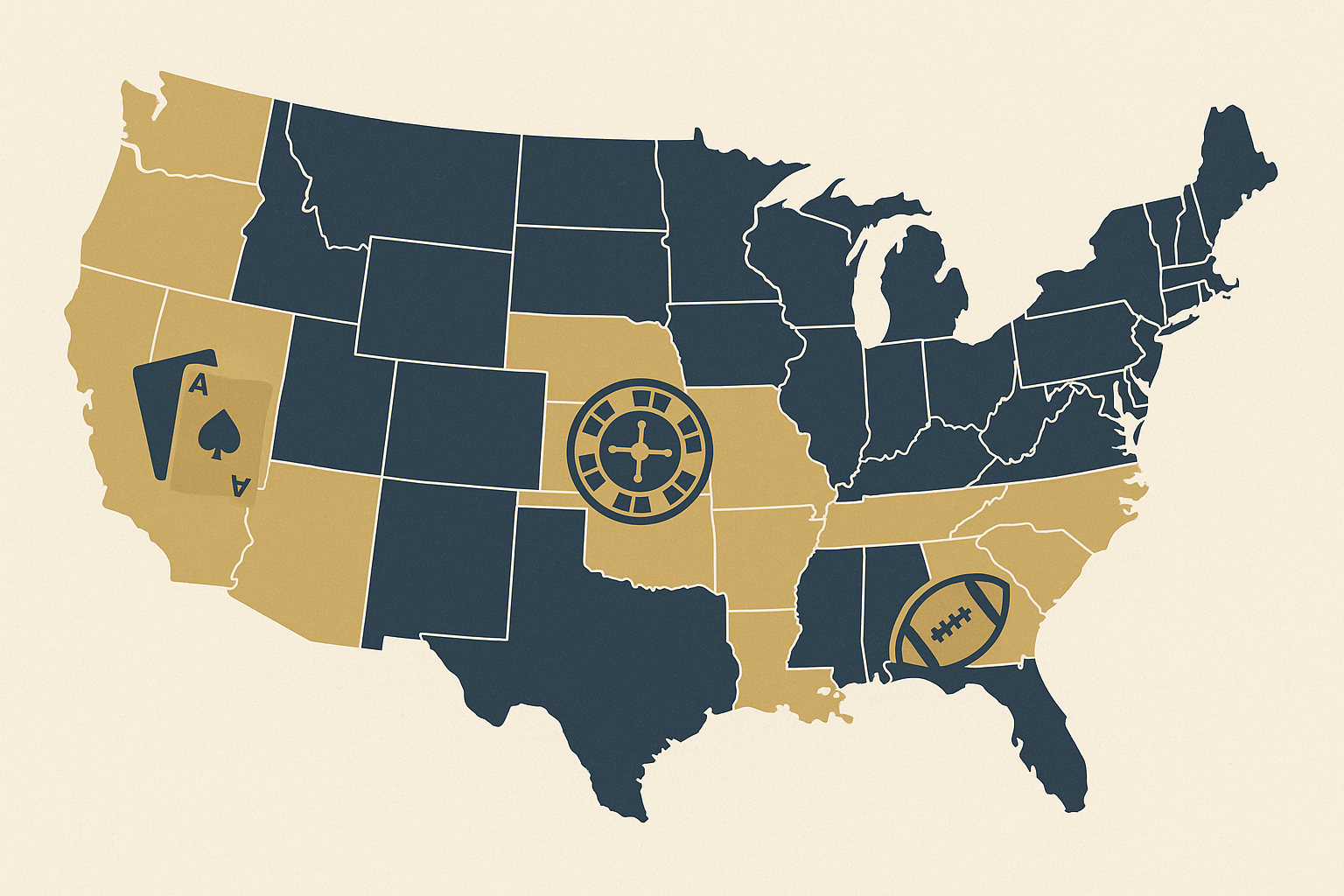
Is iGaming legal in the United States? The quick answer
Yes and no, depending entirely on where you are sitting. There is no federal law that legalizes or bans online gambling nationwide for players. Instead, each state decides for itself, and most states have made different decisions for different products. So the honest answer to “is iGaming legal” is: online sports betting is legal in around 30 states, real money online casino games are legal in only seven, and online poker exists in a handful more.
That split confuses a lot of people. A resident of Ohio can legally bet on the NFL from their phone but cannot legally play an online slot at a licensed in-state casino site. A resident of Michigan can do both. A resident of Utah can do neither, because Utah prohibits gambling outright.
The rest of this guide breaks down the federal framework, which states allow what, how licensing actually works, and why regulated operators are legally different from offshore sites. One caveat up front: gambling law changes every legislative session. This is general information, not legal advice, and you should check your own state regulator before you play.
Federal vs state legal framework for iGaming
Three federal laws shape US iGaming regulation, and none of them creates a national licensing system.
The Wire Act (1961) prohibits using wire communications to transmit bets across state lines. Its scope has been fought over for years. A 2011 Department of Justice opinion concluded it applied only to sports betting, which gave states confidence to launch online casino and poker. The DOJ reversed itself in a 2018 opinion, arguing the Act covered all forms of interstate gambling. The New Hampshire Lottery sued, and in 2021 the First Circuit Court of Appeals held that the Wire Act’s prohibitions apply only to sports wagering. The DOJ did not take the case to the Supreme Court, and states have continued to license online casino gaming since.
The Unlawful Internet Gambling Enforcement Act (2006) is often misread as a ban on online gambling. It is not. UIGEA targets the money: it prohibits businesses from knowingly accepting payments connected to bets that are already unlawful under other federal or state law. It does not make placing a bet a federal crime, and it carves out gambling that is legal within a single state under that state’s own law.
PASPA (1992) was the law that kept sports betting bottled up in Nevada. In Murphy v. NCAA (2018), the Supreme Court struck it down as unconstitutional commandeering of state legislatures. That decision did not legalize anything by itself, but it removed the federal obstacle and handed the question back to the states. The wave of sports betting bills that followed is the direct result.
Tribal gaming adds another layer. Under the Indian Gaming Regulatory Act, tribes negotiate compacts with states, which is how Connecticut’s online market was built and why several states must renegotiate compacts before they can expand online.
Which US states allow online casinos?
Seven states have licensed, regulated real money online casino gaming. Nevada allows online poker but not online casino games, which is why it is often counted separately.
Fully legal online casino states
| State | Online casino launched | Regulator | Online poker |
|---|---|---|---|
| New Jersey | November 2013 | Division of Gaming Enforcement | Yes |
| Delaware | November 2013 | Delaware Lottery | Yes |
| Pennsylvania | July 2019 | Pennsylvania Gaming Control Board | Yes |
| West Virginia | July 2020 | West Virginia Lottery | Authorized |
| Michigan | January 2021 | Michigan Gaming Control Board | Yes |
| Connecticut | October 2021 | Dept. of Consumer Protection (tribal compacts) | No |
| Rhode Island | 2024 | Rhode Island Lottery | No |
The operator mix differs by state because online licences are usually tied to a land-based casino or, in Connecticut and Rhode Island, to a single partner. New Jersey, Pennsylvania and Michigan have the most competitive markets, with brands including DraftKings, FanDuel, BetMGM, Caesars, Borgata and Golden Nugget running licensed casino apps. Connecticut’s market is limited to two operators partnered with the Mohegan and Mashantucket Pequot tribes plus the state lottery. Delaware runs its online casino through the state lottery with a single platform provider, and Rhode Island’s is operated through Bally’s.
States with limited online gaming
Several states allow something online without allowing full casino play:
- Nevada permits licensed online poker only. No online slots or table games.
- Online poker liquidity is shared between some states under the Multi-State Internet Gaming Agreement, an interstate compact that lets operators pool players across state lines so poker tables can actually fill. Delaware, Nevada, New Jersey, Michigan and West Virginia have signed it.
- Lottery courier and iLottery states sell draw games and instant-win games online without licensing casino gaming. Legally these are lottery products, not casino products.
- Sweepstakes and social casinos operate in most states under a different legal theory (no purchase necessary, prizes via sweepstakes rules). Several state regulators and attorneys general have challenged that model, so treat it as unsettled rather than “legal everywhere”.
Sports betting vs online casino: different legal status
Roughly 38 states plus Washington, D.C., have legalized sports betting in some form since 2018, and about 30 of those offer statewide mobile betting. Compare that to seven online casino states, and the gap is enormous. A few reasons explain it:
- Murphy v. NCAA created a single, well-publicized moment for sports betting bills. Online casino never had an equivalent trigger.
- Sports betting was easier to sell politically. Legislators framed it as capturing an existing illegal market and taxing fan engagement. Online slots carry more stigma.
- Land-based casino operators and casino workers’ unions in several states have opposed iGaming out of concern that it cannibalizes brick-and-mortar revenue and jobs. New Jersey and Pennsylvania data suggests online growth has not gutted land-based revenue, but the argument still lands with lawmakers.
- Some states must reopen tribal compacts to authorize online casino gaming, which is slower and more contentious than passing a sports betting bill.
Online poker is the smallest category of all, because a poker room needs enough simultaneous players to work. That is why interstate compacts matter more for poker than for any other product.
How iGaming licensing and regulation work
In regulated states, an iGaming license is issued by a state gaming commission, control board or lottery, and it comes with conditions that go well beyond “pay a fee”. Typical requirements include:
- Suitability review. Owners, executives and major shareholders undergo background and financial investigations. Regulators can and do deny applicants.
- A land-based or tribal tether. Most states only issue online licences to, or in partnership with, an existing in-state casino, racetrack or tribe.
- Independent game testing. Random number generators and game math are certified by accredited test labs, and advertised RTP must match the certified build. A 96% RTP slot returns about $96 per $100 wagered over the long run, which is also a plain statement that the house edge is 4%.
- Geolocation. Software must confirm you are physically inside state lines on every session. This is why a legal New Jersey account stops working the moment you cross into New York.
- Age verification and KYC. Identity documents are checked before withdrawals, and the minimum age is 21 in most iGaming states, though some states set 18 for certain products.
- Responsible gaming tools. Deposit, loss and session limits, cool-off periods, reality checks and a state self-exclusion list that blocks you at every licensed operator in that jurisdiction.
- Reporting and tax. Operators file revenue reports and pay state gaming taxes, which vary widely. Pennsylvania taxes online slot revenue at a far higher rate than table games, for example.
Suppliers need licences too. In most states the game studio, the platform provider and the payment processor all hold their own approvals, which is why the same slot can be certified in one state and unavailable in another.
Legal operators vs offshore sites: what’s the difference?
Offshore sites accept US players from jurisdictions outside the country and are not licensed by any US state. They are not “illegal to play at” in the sense of a player prosecution risk in most states, but they sit outside the entire consumer protection framework, and some states explicitly prohibit unlicensed online gambling. The practical differences matter more than the theory.
| Factor | State-licensed operator | Offshore site |
|---|---|---|
| Oversight | State regulator with enforcement power | Foreign licence or none; no US authority |
| Dispute resolution | File a complaint with the state regulator | Usually nothing enforceable |
| Game fairness | RNG and RTP certified by approved labs | Varies; often unverifiable |
| Player funds | Segregation and reserve requirements | No US requirement |
| Self-exclusion | Honors the state exclusion list | Not connected to state lists |
| Tax paperwork | Issues W-2G forms where thresholds apply | No US reporting |
On taxes, the rule is the same either way: gambling winnings are taxable income in the US regardless of where the operator is based. The difference is that a licensed operator generates the paperwork and withholding, while offshore play leaves the reporting entirely on you. Consult a tax professional for your situation.
Is iGaming the same as gambling legally?
Yes. iGaming is gambling. Legally, a wager is a wager whether you place it at a table or on a phone, and state gambling statutes generally define it the same way: risking something of value on an uncertain outcome for a prize. The word “iGaming” is industry shorthand for the online delivery channel, mostly online casino and poker, sometimes used to exclude sports betting.
What is legally distinct is the regulatory overlay. Because there is no dealer looking at your ID and no floor supervisor watching your session, digital gambling laws add requirements a physical casino does not need: geolocation checks, server and data location rules, mandatory account limits, automated affordability and problem-play monitoring in some states, and advertising restrictions specific to online channels. Skill-based games, fantasy sports and sweepstakes models sit in their own contested corners of the law, and several states classify them differently from casino gaming.
If you play, treat it as paid entertainment with a built-in house edge, not a way to make money. Set deposit and time limits before your first session and use the operator’s responsible gaming tools. If gambling stops feeling like a choice, the National Council on Problem Gambling offers free, confidential help, and the 1-800-GAMBLER helpline operates nationwide. Our responsible gambling guide covers the tools available at licensed US sites.
Frequently asked questions
Which US states allow online casinos?
New Jersey, Delaware, Pennsylvania, West Virginia, Michigan, Connecticut and Rhode Island license real money online casino gaming. Nevada allows licensed online poker only.
How is iGaming regulated in the US?
By individual states. A state gaming commission, control board or lottery licenses operators and suppliers, certifies game software through independent test labs, enforces geolocation and age verification, and requires responsible gaming tools. Federal law shapes the edges, mainly through the Wire Act and UIGEA, but does not license operators.
What licences do iGaming operators need?
A state operator licence, usually tied to a land-based casino, racetrack or tribal partner, plus separate licences or approvals for platform providers, game studios and key personnel. An operator must hold a licence in every state where it takes bets.
Is online poker legal in the US?
It is legal in a small group of states, including Nevada, New Jersey, Delaware, Pennsylvania, Michigan and West Virginia. Several of them share player pools through an interstate compact so tables can fill.
Can I use a legal US casino app while travelling?
No. Geolocation ties your account to the licensed state. Cross the border and the games lock, even though your account stays open.
Laws and launch dates change. Verify the current status with your state gaming regulator before you deposit. Gambling is for adults only, typically 21+ in iGaming states.