
What is iGaming software?
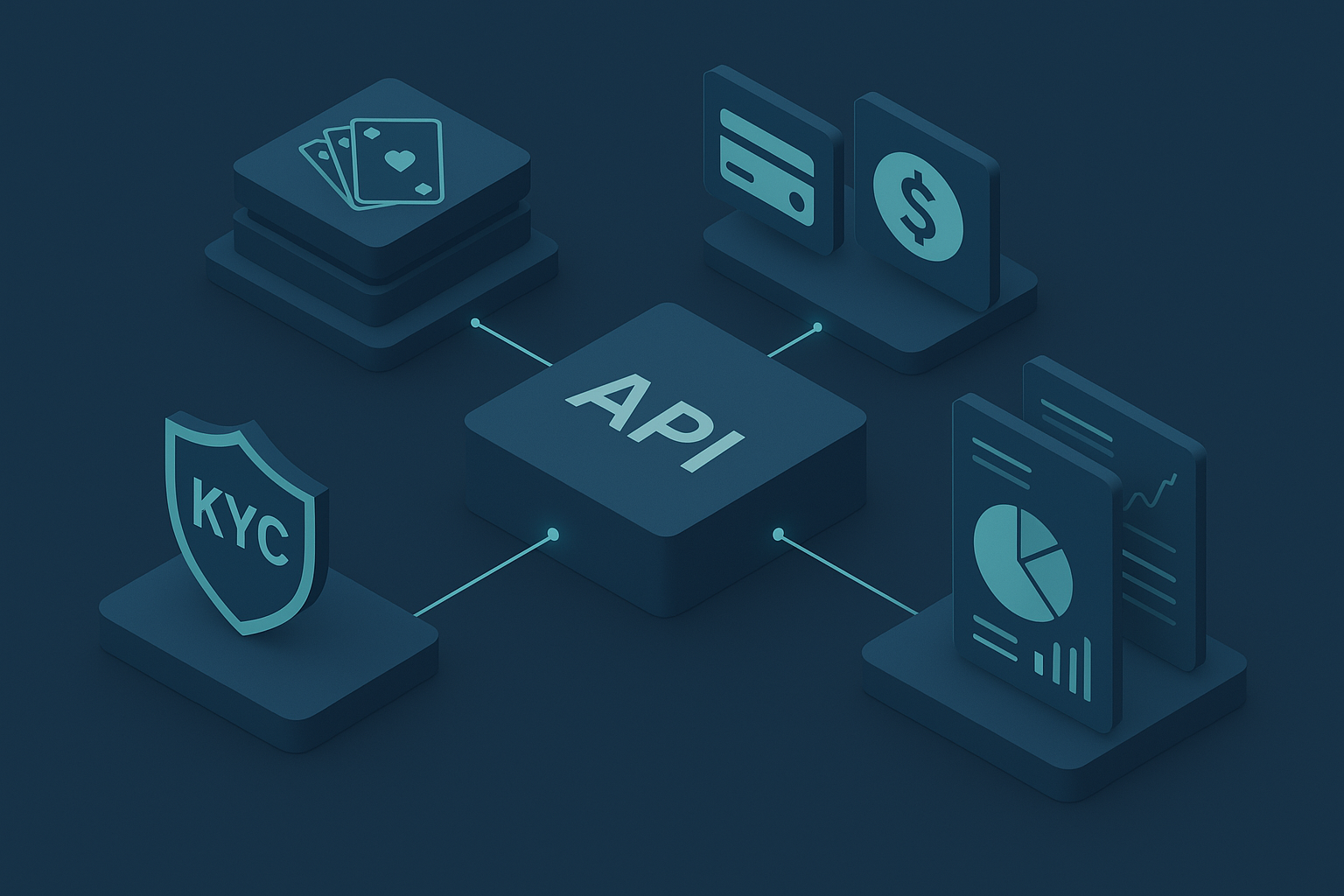
iGaming software is the full technology stack an online casino or sportsbook runs on: the platform that manages players, wallets and bets; the games and betting markets that sit on top of it; and the back-office tools that handle payments, compliance and reporting. Almost none of it is built by the operator itself. Most brands you see are assembling licensed B2B components.
That distinction matters if you’re evaluating the sector. An “online casino” is usually a brand, a licence and a commercial team sitting on top of software supplied by three or four different vendors, glued together with APIs.
Core components overview
- Platform (player account management) — registration, wallet, bonusing engine, session handling, responsible gambling limits, regulatory reporting.
- Game content — slots, live dealer tables, crash games, virtual sports, supplied by game studios or bundled by an aggregator.
- Sportsbook engine — odds feeds, market creation, bet acceptance, risk management, cash-out logic.
- Payments layer — a payment orchestration setup connecting card acquirers, e-wallets and local bank rails.
- Back office and BI — reporting, segmentation, CRM, fraud and AML monitoring, KYC workflows.
- Front end — the website and apps, often themeable templates rather than bespoke builds.
Platform vs games vs services
Think of it as three layers with different economics. The platform is infrastructure: you pay for uptime, compliance coverage and integrations. Games are content: you pay per game round or as a share of revenue generated on that supplier’s titles. Services (payments, KYC providers, affiliate tracking, live chat) are utilities billed per transaction or per check.
Confusing these layers is the most common mistake newcomers make. A game studio cannot run your casino; a platform vendor does not make its own slots — or if it does, that’s a separate product line with its own certification.
iGaming platforms: the foundation
An iGaming platform is the central system that holds the player account and the money. Every bet, bonus, deposit and withdrawal passes through it, and every regulator audits it. If the platform goes down, the brand goes down, regardless of how good the games are.
Platform core features
- Player account management (PAM) — the single source of truth for identity, balance and history. In some regulated markets the PAM is the specific component the regulator certifies and monitors.
- Wallet — single-wallet architecture is now standard: one balance usable across casino, live and sports, with game sessions funded via API calls rather than transfers between separate wallets.
- Bonus engine — deposit matches, free spins, cashback, wagering requirements and game weighting rules. Weighting (slots often contributing 100% toward playthrough, table games far less) is enforced here, not by the game itself.
- Responsible gambling tools — deposit, loss and session limits, cool-off and self-exclusion, reality checks, plus hooks into national self-exclusion registers where they exist.
- Reporting and regulatory feeds — automated submissions in the formats a given licensing authority demands.
White label vs custom solutions
Operators generally pick one of three routes, and the trade-off is control against speed and cost.
| Model | Who holds the licence | Typical launch effort | Best for |
|---|---|---|---|
| White label | The white label provider (operator runs a brand under it) | Fastest — brand, site and payments largely pre-assembled | Affiliates and marketing-led teams testing a market |
| Turnkey / licensed platform | The operator | Moderate — platform is off the shelf, licensing and payments are the operator’s job | Operators wanting control of the licence, contracts and player data |
| Custom or in-house build | The operator | Longest and most expensive; ongoing engineering headcount required | Large operators with proprietary products or unusual market needs |
White label is attractive because someone else has already solved compliance and payments. The catch is that you are a tenant: the licence, the merchant accounts and often the player relationship belong to the provider, and revenue share reflects that.
Integration capabilities
Judge a platform by its integration surface. Practical questions: does it expose a documented REST API for player, wallet and transaction data? Can you plug in your own CRM, affiliate system or payment orchestrator, or are you locked into the vendor’s? How many game suppliers and payment providers are already certified on it in your target market? Every integration that already exists is weeks you don’t spend.
Game providers vs game aggregators
Game providers build games. Aggregators bundle other people’s games and resell access through one connection. Both are iGaming providers, but they do opposite jobs.
Game provider role
A provider (or game studio) designs the game, writes the maths model, sets the RTP and volatility, gets it certified, and hosts the game server itself. When a player spins a slot, the round is usually calculated on the provider’s infrastructure, not the casino’s — the platform only debits and credits the wallet. Well known examples include Evolution in live dealer, Pragmatic Play, Play’n GO, Playtech and Light & Wonder in slots and table content.
How do game aggregators work?
An aggregator maintains its own integrations with dozens or hundreds of studios and exposes them to the operator through a single API and a single contract. The operator integrates once; the aggregator handles per-studio protocol differences, game launch URLs, free-round campaigns, reporting normalisation and reconciliation.
Technically the flow is straightforward: the operator’s platform requests a game launch through the aggregator, the aggregator routes to the studio, and wagering callbacks come back through the aggregator to the operator’s wallet API. One authentication scheme, one transaction format, one set of reports.
Benefits of aggregated content
- Hundreds of titles live from one integration instead of one commercial and technical project per studio.
- A single monthly reconciliation and invoice rather than dozens.
- Faster access to new studios, which are often integrated with major aggregators before they build direct connections.
- Central tooling for bonuses like free rounds across multiple providers.
The trade-offs: an extra revenue share layer, another dependency in the uptime chain, and less direct commercial leverage with the studios themselves. Large operators typically run a hybrid — direct integrations with their top-performing providers, aggregation for the long tail.
RNG software and fair play certification
RNG software is what makes casino game outcomes random and independent. It’s also the part regulators scrutinise hardest, because it’s the part players cannot see.
How RNG technology works
A random number generator produces a stream of unpredictable numbers that the game maps onto reel positions, card values or wheel results. Each round is independent: previous outcomes have no effect on the next one, which is why “hot” and “cold” machines don’t exist and why no betting pattern changes a game’s expected return.
The maths model sitting on top of the RNG defines the return to player. A 96% RTP means the game is designed to return about 96% of all wagers over millions of rounds, leaving a 4% house edge. Volatility describes how those returns are distributed — high volatility means rarer, larger wins — but it does not change RTP, and neither figure predicts what happens in a single session.
How is RNG software certified?
Independent test laboratories accredited by gaming regulators do the work. The main names are Gaming Laboratories International (GLI), BMM Testlabs, iTech Labs and eCOGRA. A typical certification sequence:
- Statistical testing of the RNG output for randomness, distribution and unpredictability.
- Source code and maths review to confirm the game’s theoretical RTP matches its documentation and paytable.
- Simulation of large volumes of rounds to verify actual returns converge on the theoretical figure.
- Testing against the technical standards of each target jurisdiction — requirements differ between, for example, a US state regulator and a European licensing authority.
- Issue of a certificate tied to a specific game build and version.
Ongoing compliance requirements
Certification is not one and done. Any change to a game’s maths or RNG implementation requires recertification, builds are checksum-verified against the approved version, and licensed operators are commonly subject to periodic audits comparing actual payout data against the certified RTP. For an operator, insisting on current certificates for every supplier is basic due diligence; for a player, a named test lab and a verifiable licence are the practical signals that a game hasn’t been tampered with. If you’re new to how licensing bodies differ, our guide to iGaming regulation and licensing covers that side in more detail.
Back-office and payment integration
The back office is where an iGaming provider earns or loses its reputation with operators. Games drive acquisition; the back office determines whether the business is manageable.
Business intelligence tools
Standard expectations: real time dashboards for turnover, gross gaming revenue, margin and active players; cohort and lifetime-value reporting by acquisition source; game-level performance data; and bonus cost tracking per campaign. Serious operators also want raw data access — a warehouse export or streaming feed — so analysts aren’t limited to the vendor’s canned reports.
Payment processing integration
Payments in this industry are geography-specific. A platform needs the local rails players actually use, and cashier logic that routes each transaction to the acquirer most likely to approve it. What to look for:
- Pre-integrated payment providers in your licensed markets, including local bank transfer and wallet methods.
- Cascading and smart routing to lift approval rates.
- Withdrawal automation with configurable manual review thresholds.
- Chargeback and dispute handling, plus reconciliation reporting that finance can actually use.
Payout speed is largely a back-office question rather than a payment-method question: automated withdrawal approval and completed KYC are what turn a two-day cashout into a two-hour one. Our overview of casino payment methods looks at this from the player side.
Compliance and reporting
Expect built-in KYC orchestration (document capture, identity and age verification, sanctions and PEP screening), AML transaction monitoring with configurable rules and suspicious activity workflows, affordability and responsible gambling triggers, audit logging, and jurisdiction-specific regulatory reports. Data residency also matters — several regulators require player data and game logs to be hosted in-country.
How operators choose software providers
Selection comes down to whether the vendor is already certified where you want to operate, whether the commercial model matches your scale, and how much engineering work lands on your side.
Key selection criteria
- Market coverage — is the platform certified and live with other operators in your target jurisdictions? Retrofitting a platform for a new regulator is slow and expensive.
- Content depth — direct studio relationships plus aggregation reach, and the specific titles that perform in your markets.
- Payments — existing local integrations and demonstrated approval rates beat a long generic list of providers.
- Reliability — contractual uptime, incident history, and behaviour during peak events such as major sports finals.
- Support model — named account management and a real escalation path, not a shared inbox.
- Data ownership — who owns the player database, and can you export it if you migrate?
Pricing and contract models
Three structures dominate. Revenue share, usually a percentage of gross gaming revenue, keeps upfront costs low and scales with success. Fixed monthly licence fees suit high-volume operators who don’t want to share upside. Hybrid deals combine a smaller fee with a lower revenue share. On top of that, expect one-off setup and integration fees, per-game or per-round content costs passed through from studios, and per-check charges for KYC and payment services. Watch the terms as closely as the rate: minimum contract length, exclusivity clauses, migration assistance and exit provisions decide how trapped you are in three years.
Implementation considerations
Realistic timelines depend on the route: white label launches are measured in weeks, a licensed platform integration in months once licensing and payment onboarding are factored in, and a custom build considerably longer. Budget time for licence applications, test lab sign-off on your specific configuration, payment provider underwriting, and user acceptance testing across deposits, withdrawals, bonuses and edge cases like partial cash-outs. Migrating an existing player base adds another layer: balances, bonus states, KYC records and self-exclusion flags all have to transfer intact, and self-exclusions must never be lost in a migration.
One closing note for anyone building on this stack: the responsible gambling tools are not a checkbox. Limits, cool-off periods, self-exclusion and reality checks are the features that keep a licence intact and keep players safe, and they deserve the same testing rigour as the wallet. Gambling carries a mathematical house edge in every game; software that makes control easy is the industry standard operators should be holding themselves to.
FAQ
What is an iGaming platform?
It’s the core system that manages player accounts, the wallet, bonuses, responsible gambling limits and regulatory reporting for an online casino or sportsbook. Games and payment methods are integrated into it, not built into it.
How do game aggregators work?
An aggregator holds integrations with many game studios and exposes them through one API and one contract, routing game launches and wagering callbacks between the operator’s wallet and each studio’s game server.
Who certifies RNG software?
Independent test labs accredited by regulators, including GLI, BMM Testlabs, iTech Labs and eCOGRA. They test randomness statistically, review the maths model against the published RTP, and certify a specific game build for specific jurisdictions.