
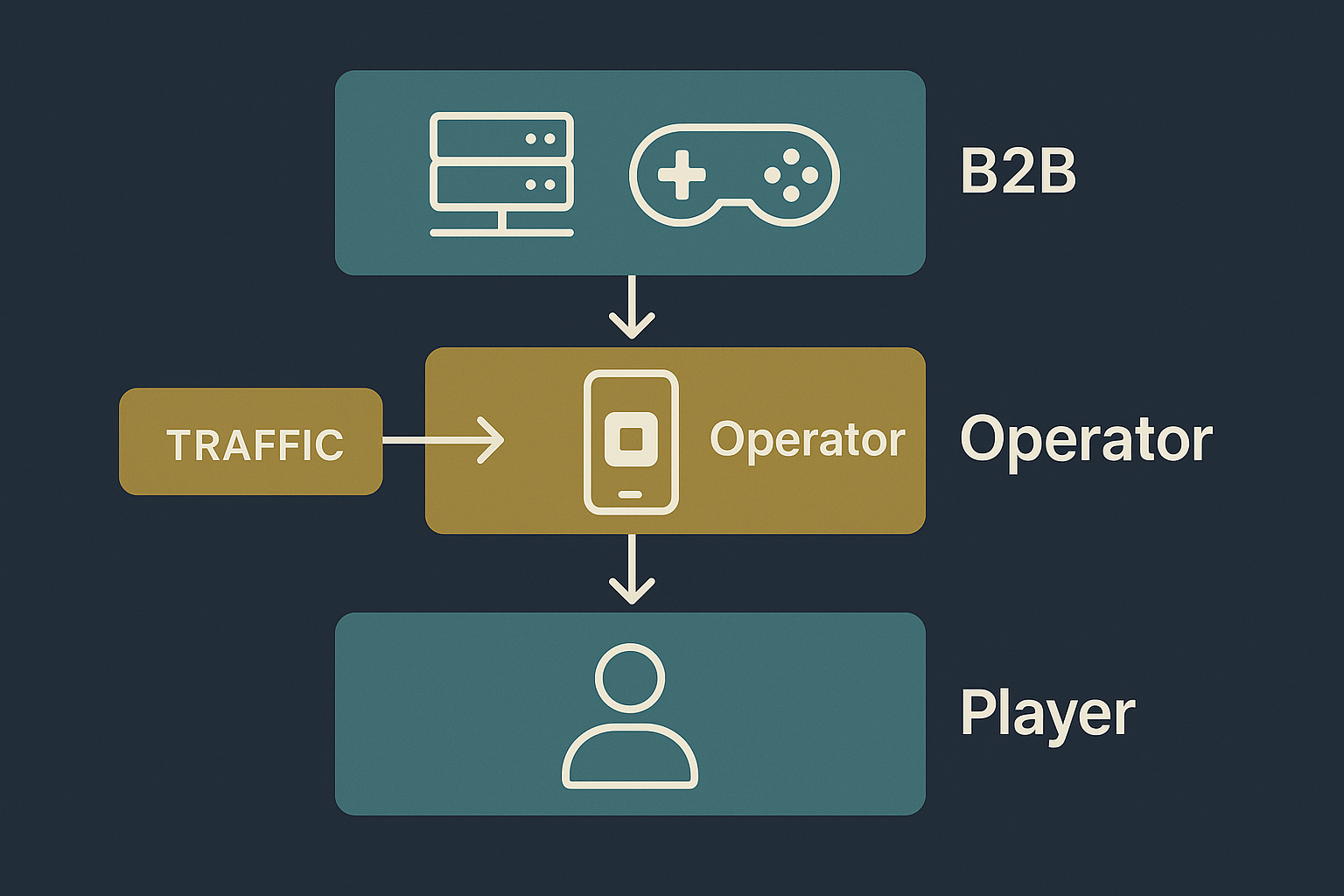
The three-tier iGaming industry structure
The iGaming industry is built on three commercial layers: platform providers and game studios that supply the technology (B2B), operators that hold licences and run consumer-facing brands (B2C), and affiliates that send traffic to those brands in exchange for commission. Money flows in the opposite direction of the product. Players fund operators, operators pay providers and affiliates, and regulators and tax authorities take a cut along the way.
The simplest way to picture it: game studios and platform providers → operators → players, with affiliates positioned in front of operators as an acquisition channel, and payments, KYC and compliance vendors bolted onto the operator layer.
Each layer has a different risk profile. Providers earn recurring revenue with little regulatory exposure to end customers. Operators carry the licences, the marketing spend, the tax burden and the volatility of player results. Affiliates carry almost no fixed cost and almost no liability for gameplay, which is why the tier attracts small teams and media companies alike.
Platform providers (B2B layer)
These are technology and content companies. Some build the account, wallet and back-office system that a casino or sportsbook runs on. Others build the games themselves: slots, live dealer tables, bingo, virtual sports. A third group aggregates content, giving an operator access to thousands of games from dozens of studios through a single integration.
Operators (B2C layer)
Operators are the brands players recognise. They hold the state or national licence, take the deposits, set bonus policy, pay gaming tax and answer to the regulator for responsible-gambling controls. Most licence rather than build their core technology.
Affiliates (traffic layer)
Affiliates are publishers, comparison sites, review portals, streamers and media buyers who route qualified players to operators via tracked links. They are paid on performance, not on impressions, which makes affiliate marketing a variable-cost acquisition channel in a sector where paid search and social advertising are heavily restricted.
What is an iGaming platform provider?
An iGaming platform provider licenses the technology stack an operator needs to run a real-money gambling site: player accounts, wallet, bonus engine, game integrations, reporting and regulatory tooling. The provider does not take bets in its own name. It sells software and content to licensed operators, usually for a share of revenue plus fees.
White-label vs turnkey solutions
These two models get used interchangeably and they are not the same thing. Under a white-label arrangement, the provider’s own gaming licence covers the site, and the client effectively rents a brand slot on someone else’s regulated infrastructure. Under a turnkey deal, the client obtains its own licence and takes control of the operation, using the provider’s platform underneath.
| Factor | White label | Turnkey |
|---|---|---|
| Licence holder | Provider | Client (operator) |
| Time to launch | Weeks to a few months | Months, tied to licensing timelines |
| Upfront cost | Lower setup fee | Higher: licence, capital, compliance staff |
| Control of payments and terms | Limited | Full |
| Revenue retained | Lower (provider takes a larger share) | Higher |
| Typical buyer | Media brands, first-time entrants | Funded operators building long term equity |
Core platform services
- Game aggregation: one integration that unlocks content from many studios, with the aggregator handling certification and reporting per market.
- Payment processing: orchestration across card acquirers, bank transfer rails, e-wallets and prepaid products, plus fraud screening and chargeback handling.
- Compliance tooling: KYC and age verification, geolocation, self-exclusion register checks, deposit and loss limits, regulator reporting feeds.
- CRM and bonus engine: segmentation, free spins and matched-deposit mechanics, wagering-requirement tracking.
- Back office: liability dashboards, RTP and margin reporting, risk management for sportsbook.
Leading platform providers
The B2B tier includes Evolution, which dominates live dealer content and owns slot studios including NetEnt and Red Tiger; Playtech, which sells both content and a full platform; Light & Wonder and IGT on the content and lottery side; and Kambi and OpenBet in sportsbook technology. Aggregators and platform vendors such as SoftSwiss, EveryMatrix and GAN sit alongside them. Several of these are publicly listed, which makes their filings a useful benchmark for B2B margins.
How iGaming operators work (B2C companies)
An iGaming company on the B2C side monetises the gap between what players wager and what games return. Gross gaming revenue (GGR) is total wagers minus player winnings. Net gaming revenue (NGR) subtracts bonus costs and, in some reporting standards, payment fees and provider royalties. Everything downstream, gaming tax, marketing, affiliate commission, sits between NGR and actual profit.
Operator business model
The mechanics differ by vertical. Online slots carry a built-in house edge, typically 3% to 6% of each wager (RTP of roughly 94% to 97%), and that edge is what an operator holds over the long run. Sportsbooks work differently: they price markets with an overround and hold a single-digit percentage of handle, commonly in the 7% to 10% range on a full-year basis, with wide monthly swings. Live casino and table games sit in between, with lower house edges but high engagement.
Because the edge per wager is thin, operator economics depend on retention and cross-sell. A player recruited by a sportsbook who also plays casino games is materially more valuable, which is why nearly every US sportsbook with an iGaming licence runs both products in one app.
Licensing and compliance requirements
In the US, online gambling is licensed state by state, not federally. Online casino gaming is live in a small group of states, including New Jersey, Pennsylvania, Michigan, West Virginia, Delaware, Connecticut and Rhode Island, while online sports betting is legal in a much larger group, roughly three dozen states plus the District of Columbia. Requirements typically include a partnership or tether with a land-based licensee, supplier licensing for every vendor in the chain, geolocation and 21-plus age verification, plus responsible-gambling controls.
Tax is the single biggest variable in operator margin. New Jersey taxes online casino gross revenue at 15%; Pennsylvania applies 54% to online slot revenue and a much lower rate to table games. Rates change with legislation, so any commercial model should be built against current statute rather than a market average. Outside the US, the Malta Gaming Authority and the UK Gambling Commission are the reference regimes most B2B contracts are written around. [Publisher note: attach current state tax citations and the American Gaming Association or state regulator source.]
Major operator brands
In the US, DraftKings and FanDuel (Flutter) lead by market share, with BetMGM, Caesars, Fanatics Betbook and ESPN Bet competing behind them. In online casino specifically, BetMGM has historically been strong, and brands such as Golden Nugget Online, Borgata and Hard Rock trade on land-based recognition. In Europe, Flutter, Entain, bet365, Betsson and Kindred are the reference names. For background on how the vertical is defined and regulated, see our guide to what iGaming means and our overview of US online gambling regulation.
How iGaming affiliates make money
iGaming affiliates are paid by operators for delivering depositing players. There are three standard structures: revenue share, cost per acquisition, and hybrids that combine both. Nothing is paid for traffic alone, which is why serious affiliate businesses look more like performance-marketing companies than publishers.
Revenue share model
The affiliate earns an ongoing percentage of the net revenue generated by players it referred, commonly 25% to 40%, sometimes tiered so higher volume unlocks a higher rate. The upside is annuity income from a single acquisition. The catch is that revenue is calculated on NGR after bonus costs and, in some contracts, after gaming tax, and many deals include negative carryover, meaning a losing month for the operator rolls forward against future commission.
CPA (cost per acquisition)
A flat fee per qualifying player, triggered by a minimum deposit and sometimes a minimum wagering threshold. In competitive US markets CPAs are frequently quoted in the low hundreds of dollars per player, and they vary sharply by state, product and traffic quality. CPA converts a long-tail revenue stream into immediate cash, which suits media buyers funding ad spend. Operators offset the risk with clawback clauses for fraudulent or bonus-only signups.
Traffic generation methods
- SEO-driven review and comparison sites, still the largest single channel because paid options are constrained.
- Content and email lists, particularly sports previews and odds content.
- YouTube, podcasts and streaming partnerships with disclosed sponsorship.
- Paid media where permitted, including search, programmatic display and app install campaigns.
- Media licensing deals, where a publisher rents its brand to an operator rather than selling clicks.
Compliance is not optional at this tier. Several US states require affiliates to register or hold a vendor licence, creatives must carry age restrictions and problem-gambling helpline messaging, and claims cannot be misleading, including anything implying guaranteed or expected profit. Bonus terms such as wagering requirements should be stated plainly, because a “100% up to $500” headline means little without the 30x playthrough attached to it.
Revenue models across the iGaming value chain
Money moves in one direction and value in the other. Players deposit with operators. Operators pay content royalties and platform fees upstream, commission to affiliates sideways, and gaming tax to the state. Whatever survives that is operating margin. The ranges below are widely reported commercial norms and are negotiated per deal, not fixed rates.
| Tier | Paid by | Model | Typical commercial range |
|---|---|---|---|
| Game studio / content | Operator | Royalty on GGR from its games | Roughly 10%–15% of GGR |
| Aggregator | Operator | Share of the studio royalty plus integration fees | A slice of the content royalty |
| Platform (turnkey) | Operator | Setup fee, monthly licence, revenue share | Single-digit to low-teens % of GGR |
| Platform (white label) | Brand owner | Higher revenue share, provider holds the licence | Materially higher than turnkey |
| Affiliate | Operator | Revenue share, CPA, or hybrid | 25%–40% NGR, or a per-player CPA |
| State / regulator | Operator | Gaming tax on GGR plus licence fees | 15% in NJ to 54% on PA online slots |
The practical takeaway for anyone modelling entry: the operator tier looks like the biggest revenue line and is the thinnest on margin. Content and platform providers earn less per player but keep far more of it, with no tax on gaming revenue and no player liability.
iGaming industry market size and growth
Global online gambling revenue is measured in the tens of billions of dollars annually, with published estimates ranging from roughly $80 billion to well over $100 billion depending on whether lottery, poker, esports betting and grey markets are included. Treat any single headline number with caution, because analyst methodologies differ enough to make direct comparisons misleading. Regulator-reported figures are the reliable base.
Global market size
Europe remains the largest regulated region by revenue, with the UK, Italy, Sweden and Germany among the biggest single markets. Latin America is the most active expansion story, driven by Brazil’s regulated launch. Asia is large but fragmented and, in many jurisdictions, restricted.
US market growth
The US is the fastest-growing regulated market of the past decade, following the 2018 Supreme Court decision in Murphy v. NCAA that struck down the federal sports-betting ban and left the question to individual states. The American Gaming Association reports record annual commercial gaming revenue in the US, with online sports betting and iGaming accounting for a growing share of the total. Notably, online casino generates that revenue from only a handful of legal states, which is why per-state iGaming revenue is a closely watched metric for expansion cases. [Publisher note: insert latest AGA Commercial Gaming Revenue Tracker figures and citation before publication.]
Key growth drivers
- New state legalisation for online casino, which lags sports betting significantly.
- Cross-sell from sportsbook databases into higher-margin casino products.
- Live dealer content and game-show formats, which lifted engagement and average session value.
- Payments improvement, including instant bank transfer and higher card acceptance rates.
- Media and sports partnerships that lower acquisition cost through owned distribution.
Working against those drivers: rising tax rates in several jurisdictions, tighter advertising and bonus rules, and the cost of maintaining compliance across a patchwork of state regimes.
FAQ
How is the iGaming industry structured?
In three tiers: B2B platform providers and game studios supplying technology and content, B2C operators holding licences and serving players, and affiliates generating traffic on a performance-fee basis.
What is the difference between B2B and B2C iGaming?
B2B companies sell software, games and services to gambling businesses and are licensed as suppliers. B2C companies hold operating licences, accept wagers from the public, pay gaming tax and are directly accountable to regulators for player protection.
How do iGaming affiliates make money?
Through revenue share (commonly 25%–40% of net revenue from referred players), CPA (a flat fee per qualifying depositor), or a hybrid of both. Payment depends on delivering verified, depositing players, not on traffic volume.
How big is the iGaming industry?
Global online gambling revenue runs into the tens of billions of dollars per year, with estimates varying by scope and methodology. Regulator data, such as US state gaming-board reports, gives the most defensible baseline for market sizing.
This article covers the commercial mechanics of the sector for business readers. Gambling products carry a built-in house edge and lose money for players over time. They are restricted to adults aged 21 and over in US regulated markets. If gambling is causing harm, the National Council on Problem Gambling helpline (1-800-GAMBLER) offers confidential support.